Needle In A Haystack Tools and Upgrades
Compare bags, hand speed, pitchfork, dynamite and vacuum roles in Steam App 5321400, including the official overheating limit and a useful purchase routine.
Choose an upgrade in A Game About Needle In A Haystack by identifying the stage that interrupts your search. Bigger bags address carrying space, faster hands address manual gathering, the pitchfork removes a large clump, dynamite opens a crater and the vacuum collects continuously with an overheating limit. The useful question is what you need to improve now, rather than which purchase sounds most powerful.
View reference image
On this page
Choose an upgrade in A Game About Needle In A Haystack by identifying the stage that interrupts your search. Bigger bags address carrying space, faster hands address manual gathering, the pitchfork removes a large clump, dynamite opens a crater and the vacuum collects continuously with an overheating limit. The useful question is what you need to improve now, rather than which purchase sounds most powerful.
These roles come from Little Field Studios’ official Steam description for App 5321400, checked October 18, 2026. The official store previews also show gameplay, the workshop upgrade interface and the cow. This is an explanation and comparison routine based on those sources. It does not claim a tested optimal purchase order, exact current costs or a complete catalog of everything that may appear in the game.
Compare the whole dig-and-sell cycle
An upgrade affects your experience inside a cycle: work on the pile, fill the bag, travel to the cow, sell and return. If you only look at the moment of purchase, you may miss where the benefit appears. Repeat a recognizable route before and after a change. The beginner guide explains how to establish that first routine.
You do not need to measure a perfect income-per-minute figure. Notice which part repeatedly stops your progress. Are you returning to sell while you still want to work on the same face? Does manual gathering feel slow with carrying space unused? Are you clearing broad areas without inspecting the exposed surface? Those observations describe different needs.
Keep a simple purchase note: what problem you observed, which upgrade you selected and what changed on the next cycle. That helps you distinguish an improvement from a different section of the pile or a shorter return trip. It also prevents a video creator’s late-game equipment from becoming an unexplained shopping requirement.
Bigger bags: fewer capacity interruptions
The official store explicitly offers bigger bags. The supported benefit is more carrying capacity, rather than a guaranteed improvement to every other action. Investigate a bag upgrade when you frequently stop a clear gathering rhythm to sell. Read the current capacity and price shown in the workshop instead of using an unverified table.
After purchasing, repeat the same kind of collection trip and watch when you need to return. More room can change how long you work before selling. It does not, by itself, establish that your hands pull faster or that the needle becomes easier to identify. Keep those outcomes separate when assessing the purchase.
A larger bag can also change your preferred search block. You may be able to finish inspecting a familiar face before leaving, or work longer without losing your place. This is an organizational advantage you can test, not a new mechanic claimed by this guide. If you still lose track of the area, improve your return landmark rather than assuming capacity alone will fix it.
Faster hands: improve the manual part
Faster hands is another upgrade category named by the official source. Compare it when the manual removal action is the part you find slow. Check the live description and the current purchase requirement before committing money. We do not infer a percentage increase or a maximum upgrade level from the category name.
After a hand upgrade, pay attention to the next bottleneck. If you fill your bag more quickly, selling trips may feel more frequent even though gathering improved. That does not automatically mean the upgrade failed. It means the stages interact, and carrying capacity or route organization may now deserve more attention.
For a fair comparison, keep the tool and working area familiar. Switching from hands to a different tool at the same time makes it harder to isolate what the hand upgrade changed. This routine is useful even without precise timings: one known change, one repeated task and one clear observation.
Pitchfork: remove a larger clump per swing
The official description says the pitchfork takes a large clump per swing. That establishes its broad clearing role, but it does not give this site a verified reach, cooldown, exact strand count or complete upgrade tree. Watch the official demonstration and the current tool information before expecting a particular numeric result.
When trying it, choose a piece of the pile whose boundary you can see. Observe how the removed area changes and inspect what remains afterward. A larger bite can advance the clearing work while also leaving a surface you still need to examine. Treat removing hay and noticing the needle as related but separate tasks.
Compare the pitchfork with your usual manual cycle, including the trip to sell. A tool that gathers more at once can make capacity more noticeable. If the bag becomes the main interruption, record that rather than concluding the tool needs another unexplained upgrade. The decision should follow the whole cycle.
Dynamite: an opening, followed by inspection
The official store describes throwing dynamite into the pile to blast out a crater. That is useful context for understanding the shape of its effect. Our sources do not establish an exact blast radius, a guaranteed needle interaction or whether every current upgrade affects the same properties. This page therefore does not offer a precise detonation recipe.
Use a clear purpose for a dynamite attempt, such as observing the newly exposed area. After the blast, inspect the crater and its edges before immediately moving to a distant part of the pile. This is our suggested search method. It does not claim that the needle is more likely to be in a crater or that any particular throw guarantees progress toward it.
A dramatic visual effect can feel productive even when you lose your search organization. Keep a return landmark and decide where the next inspection begins. The useful result is a cleared area you can understand, not simply the largest-looking hole. Compare the current cost with that purpose before repeating purchases.
Vacuum: continuous collection with a limit
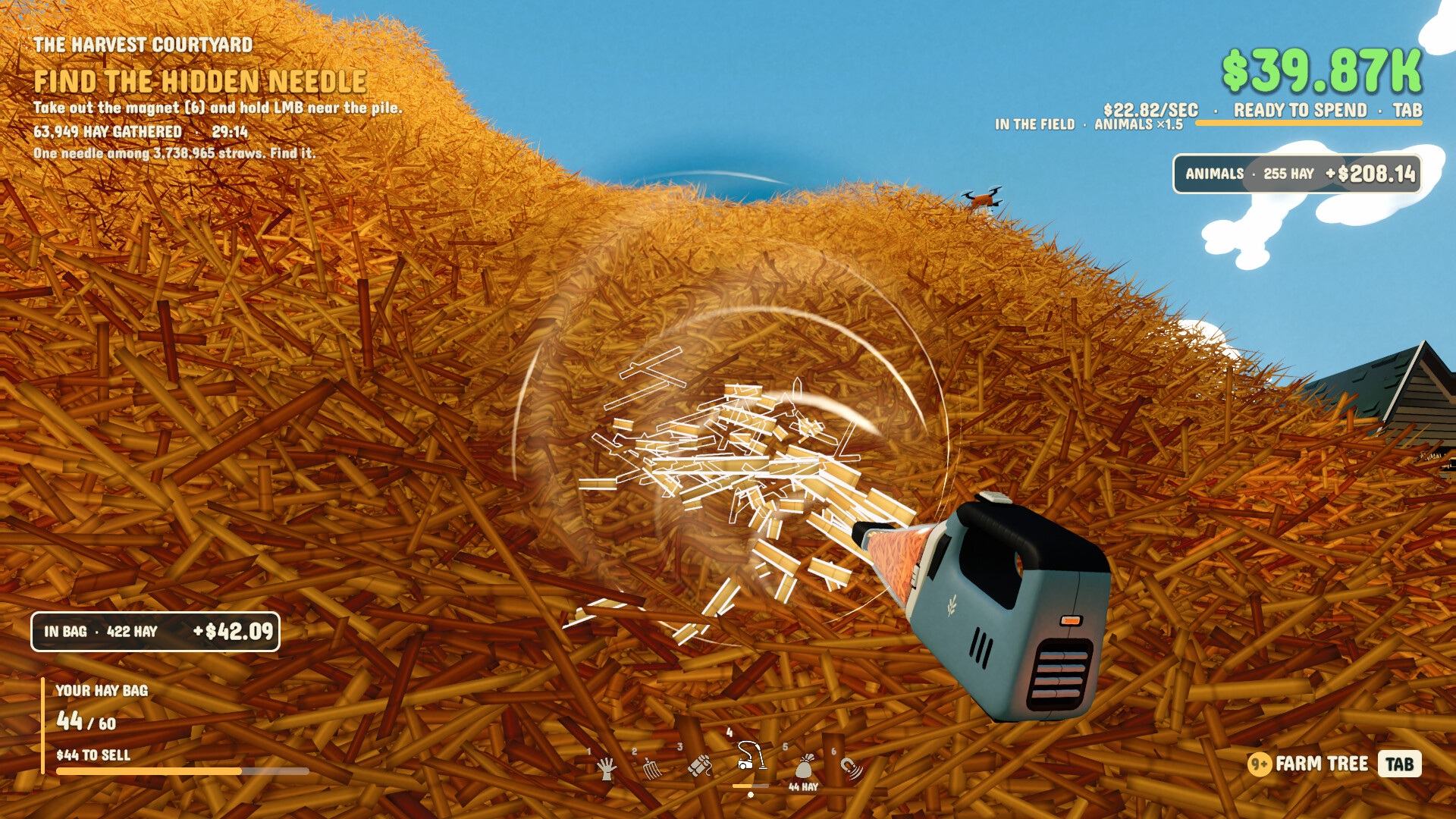
The vacuum’s continuous collection and overheating are both explicit official features. Do not read continuous as unlimited. Watch the live indicators and observe what happens during use before assuming a fixed amount of uninterrupted operation. We have not verified a universal cooling time, heat threshold or numeric upgrade table.
For a first comparison, use it in a familiar area and pay attention to when you must interrupt the action. If overheating becomes relevant, use the interruption to inspect the exposed surface and recheck the bag. This is a practical routine that respects the documented limit without inventing a cooling trick.
The official gameplay preview displays a vacuum in action, but store footage is not proof that a new save begins with that equipment. Keep the video’s setup and your own workshop state separate. Use the live unlock and purchase information to decide when the tool is available to you.
Read the workshop as a set of dependencies
The official preview of the workshop shows a connected upgrade interface. That visual helps you recognize the screen, but it is not a complete written list of current prerequisites. Read the node you intend to buy and any requirement it displays. Do not assume that every visible option is immediately purchasable or that a guide for another game uses the same branches.
Choose the next purchase around a specific search problem, then return to work before making another large change. If the outcome is uncertain, repeat a comparable cycle. Our needle search guide explains how to keep the clearing pattern organized while testing tools. No tool on this page is presented as a fixed-coordinate shortcut or a guaranteed completion button.
Quick reference
Task checks
| Situation | Check |
|---|---|
| Frequent sale trips | Check bigger-bag requirements. |
| Slow manual collection | Compare hand-speed upgrades. |
| Large clump | The official description identifies the pitchfork for this role. |
| Opening a crater | The official description identifies dynamite for this role. |
| Continuous collection | The vacuum has an overheating limit; read the current interface. |
Video evidence
Watch creator walkthroughs alongside this guide. Check the recording date before following requirements that may have changed.
Official workshop preview
Shows the connected upgrade interface; read the current node requirements before purchase.
FAQ
Which game and source does this guide cover?
This guide covers the exact Little Field Studios game linked in the sources, checked October 18, 2026. Each gameplay source has its own date.
What if the live interface differs?
Follow current game prompts and check the official listing. Send a correction with the game identity, date and observed difference to linming7277@gmail.com.
Sources
Recheck these links whenever the game version, release status, or strategy changes.
- Official A Game About Needle In A Haystack listing Identity and features checked October 18, 2026.
- Official full trailer manifest Exact official App 5321400 trailer, separate from the directly playable store preview clips.